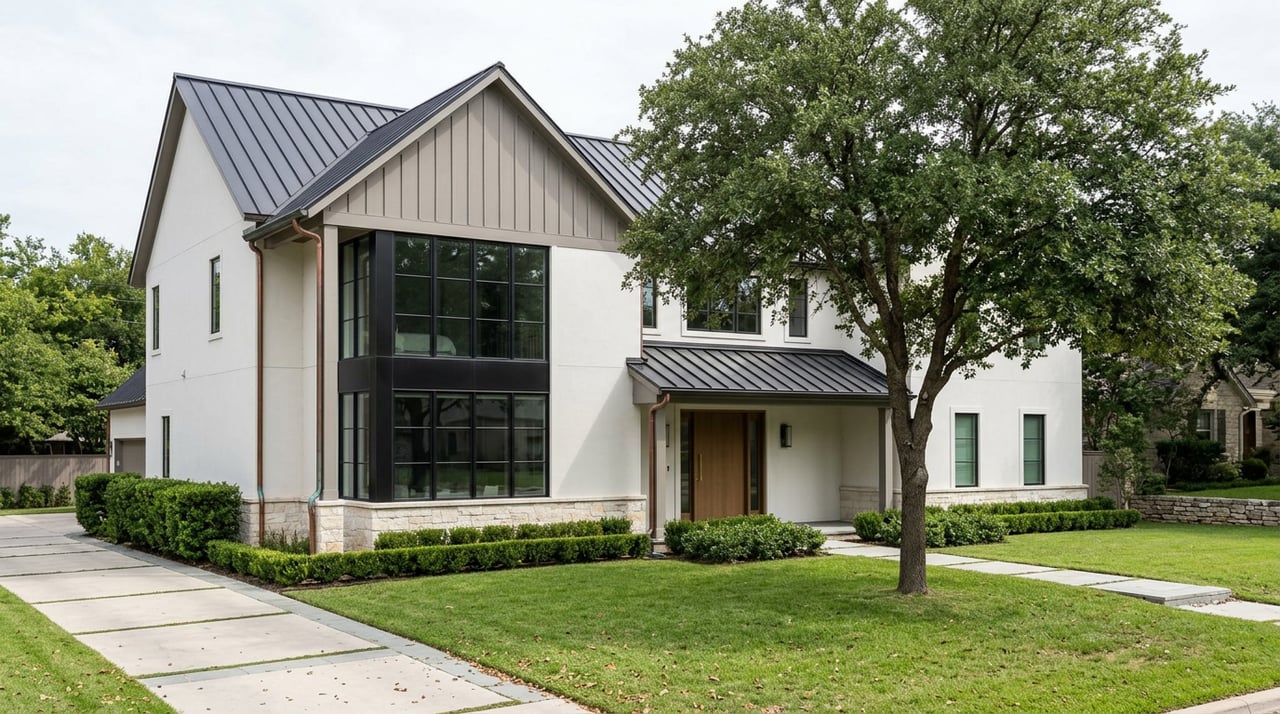
Two subdivisions sit within a few miles of each other, both built in the last fifteen years, both marketed as master-planned communities with the kind of amenities that show well in photos. Trinity Falls has a resort-style pool circuit and miles of trail. Tucker Hill has a Dutch colonial clubhouse and a fountain park residents treat like a town square. A buyer comparing them on price per square foot would call it a wash.
The tax bill says otherwise, and the reason has nothing to do with either neighborhood's amenities.
McKinney MUD 2 says that MUD 1 and MUD 2 together encompass Trinity Falls and that MUD 2 is in McKinney's extraterritorial jurisdiction. The City of McKinney says Trinity Falls is outside the city's tax jurisdiction. That means Trinity Falls homeowners pay no city of McKinney property tax at all. It also means they pay a MUD tax rate that, as of the district's 2025 adopted rate, ran $0.9847 per $100 of assessed value in MUD 1 and $1.05 per $100 in MUD 2, according to the districts' own published tax rate history. That single line item comes close to replacing an entire city-county-school tax stack on its own.
Tucker Hill takes the opposite path. Its own disclosure page states plainly that the community carries no MUD, no PUD, no SUD, and no PID. Homeowners there pay standard McKinney city tax, Collin County tax, Collin College tax, and Prosper ISD tax, landing on a combined rate of roughly $2.34 per $100 with nothing layered on top.
Same era. Same general part of McKinney. Same buyer profile shopping the same price band. Completely different math underneath the sticker price.
The financing choice hiding inside every new subdivision
A Municipal Utility District and a Public Improvement District solve the same underlying problem for a developer: someone has to pay to put in the water lines, roads, and drainage before rooftops exist to fund them through city budgets. The Texas Commission on Environmental Quality describes a MUD as a local governmental entity that can issue bonds and levy annual property taxes on property within its boundaries to pay the debt. A PID does something narrower. It funds specific improvements, frequently parks, sidewalks, or streetscape upgrades, through a special assessment that can appear as its own line item or a separate bill entirely.
Neither one is a signal about whether a neighborhood is desirable. Both Trinity Falls and Tucker Hill sell well. The difference is simply which financing tool the original developer and the city agreed on before the first foundation was poured, and that choice sticks with the land for decades regardless of who owns the house.
Craig Ranch illustrates the PID version of this math. Its PID assessment runs an estimated $0.15 to $0.50 per $100 of value, translating to roughly $525 to $1,750 a year depending on the phase and home value, funding parks and sidewalks rather than utilities. That's a fraction of what a MUD rate adds, because it's paying for a narrower slice of infrastructure.
What McKinney's own numbers reveal about the headline rate
Here's the part that catches people who compare listings by city tax rate alone. McKinney's own published breakdown shows that only 23 cents of every property tax dollar collected actually goes to the city itself, funding police, fire, streets, and parks. The rest goes to the county, the school district, and, where applicable, the special district layered on top. The city just held its own piece flat for fiscal year 2026-27, keeping the rate at $0.412284 per $100 of taxable value when the McKinney City Council adopted its budget on September 1, 2026. That stability is real, but it's also almost beside the point for a buyer trying to estimate a full bill, because the city rate was never the majority of the number to begin with.
This is why two homes at the same list price in two McKinney subdivisions can carry monthly payments hundreds of dollars apart, and why the gap has nothing to do with either home's condition, size, or finish level.
A comparison worth running before you fall for a floor plan
| Community | Special district | Approximate added cost | What it funds |
|---|---|---|---|
| Trinity Falls | McKinney MUD 1 and MUD 2 | $0.9847–$1.05 per $100 (no city tax paid) | Water, sewer, drainage, road bonds |
| Tucker Hill | None | $0 additional | N/A, standard city/county/school only |
| Craig Ranch | PID | $525–$1,750 per year, depending on phase | Parks, sidewalks, streetscape |
The lesson isn't that one of these is the right answer. A MUD tax that replaces a city tax can still land close to what a resident elsewhere pays once everything is added up. The lesson is that the only way to know which column a specific subdivision falls into is to check that subdivision by name, not to guess based on how new it looks or how much the HOA charges.
The pipeline isn't finished
This isn't only a history lesson about developments that already exist. Collin County's Commissioners Court held a public hearing on August 31, 2026, to create the Cobble Creek Public Improvement District under Chapter 372 of the Texas Local Government Code, a formal step that lets the county levy special assessments on property inside that boundary once the district is established. The county has also recently adopted a short form PID principles and parameters policy and brought on Hilltop Securities as financial advisor, P3 Works to administer PID formation, and Bracewell LLP as bond counsel, framing the tool the way county staff described it: a financing method meant to encourage higher-quality development while minimizing impact on existing county taxpayers.
What that means practically is that Collin County is actively building the administrative machinery to create more of these districts, not fewer. A parcel that looks clean on today's tax record, with no MUD and no PID, is not guaranteed to stay that way if it sits in a growth corridor the county is actively developing. For anyone evaluating raw land or an early-phase subdivision rather than a finished, occupied neighborhood, that pipeline is worth watching before it's worth assuming away.
What to actually check before you write an offer
Texas law requires sellers to disclose a MUD or PID in writing, and that disclosure should show up in your purchase contract. But waiting for the disclosure at the offer stage means you've already fallen for the floor plan. Two things are worth doing earlier:
First, pull the specific address on the Collin Central Appraisal District's property search and look at the full list of taxing units attached to that parcel, not just the city and county. A MUD will show up as its own named entity on that list.
Second, ask the builder or listing agent directly whether the community sits inside a PID and, if so, whether the assessment is a flat fee, a tiered schedule, or an ad valorem style rate tied to home value, since those structures behave very differently as the home appreciates.
A few questions worth asking before you commit
Does a MUD tax rate ever go down? Often, yes. As the district retires its bond debt over time, the tax rate tied to that debt typically declines, though the timeline depends on how the district originally structured its bonds.
Is a PID the same thing as an HOA fee? No. An HOA fee is a private contract for community upkeep and amenities. A PID is a government-created assessment tied to the land itself.
Can I confirm this before I ever see a contract? Yes. The appraisal district record and the district's own published rate history, where one exists, are public before any home goes under contract.
Comparing new construction across Collin County means comparing more than square footage and elevation options. The financing structure attached to the dirt underneath the house is often the bigger number, and it's one that a list price will never show you on its own.
Social Living Real Estate works with buyers, sellers, and landowners across McKinney and Collin County who need someone to read the fine print on a subdivision before it becomes a monthly payment. If you're comparing new-construction neighborhoods and want the tax structure explained in plain terms before you fall for a floor plan, schedule a consultation and we'll walk through it together.
This article is general information, not legal, tax or financial advice. Consult a qualified professional about your situation.